a thoughtful discussion about music

5.13.2011

"What Came First, the music or the misery?"

For those of you who think that music is purely intuitive and simple, think again.

There are many people throughout history that have thought of music as a science.
Music Theory is a complex subject, involving a lot of mathematics and also psychology.

From this point forward, there have been both musicians and scientists studying "psychoacoustics" and trying to figure out the affects that certain sounds have on our brains and emotions.

One interesting question to ask when thinking about the psychology of music arises in the film High Fidelity:
Rob: What came first, the music or the misery? People worry about kids playing with guns, or watching violent videos, that some sort of culture of violence will take them over. Nobody worries about kids listening to thousands, literally thousands of songs about heartbreak, rejection, pain, misery and loss. Did I listen to pop music because I was miserable? Or was I miserable because I listened to pop music?

Rob makes a good point in this film that I don't think many people often think about. Does the music that we listen to affect how we feel inside or do our emotions direct out musical taste? I personally listen to a lot of really emotional music, but do not consider myself a melodramatic individual, while some people who are much more emotional, listen almost solely to pop songs. I have also read in books such as Daniel Levitin's This Is Your Brain On Music that people have different ranges of musical perception and taste. Some people's brains are more pleased with more simple structures in music, while others prefer more complexity. It is a sort of development. When we are children we find simple sounds interesting and easy to understand, but at a certain point on the "complexity scale" it gets confusing or uninteresting. Then, when we grow up and our brains develop, the range of interest goes up also, some surpassing others.

As far as the whole chicken/egg (music/misery) dilemma, I personally think that the misery probably comes first. While we can say that a certain song or film makes us really sad or happy, for that emotion to persist there must be other variables within our environment that are also attributing to it. But maybe others have different perspectives and opinions...


5.07.2011

Shad: Keep Shining

I first heard this song on the Georgia State Radio while driving around in Atlanta. I was immediately drawn in by the lyrics. I am not an avid listener of a lot of rap, but good, smart lyrics always really get me.

SHAD is a artist born in Kenya to Rwandan parents and raised in London, Ontario. His style has been compared to that of K-os and Common.


CONTENT

This song is upbeat and catchy. The overall tone is positive, as is the message.

The message of the song is about respecting women and creating a society where women are encouraged to respect themselves. He talks about the rap industry and how the unbalanced nature of male vs. female rappers leads to a skewed perspective. SHAD takes the initiative to point this out and address the problem. There are not many women rappers and in many areas of our culture, women are still not fully represented or respected. This song is a good example of art pointing out and placing attention on issues within society and calling for a change.


Verse 1: I roll with clever broads
With goals like Federov
Seeking better jobs
instead of running scams like
Set It Off
Some aren't the smartest
but they know what they stand for
They don't let jams disrespect 'em on the dance floor
And though they never hit
College like the Danforth
For damn sure they got each other's back like a Jansport
Girls in a league of their own like Geena Davis
Nina Simone ladies, Tina Fey chicks
Christina Applegates and Bonita Applebums
That don't mask and say, "nothing" when you ask what's wrong
That's what's up, they can laugh it up
And they don't pass the buck
Nothin's for certain, we all have to trust
Someone I used to want to find the love of my life
Now I'm tryin' to live a life of love
It's not just a husband and wife thing
It's something that Christ brings
True beauty doesn't run from the light
Keep shining

Verse 2: And I've been known to talk about women on a track or two
I talk to women, I just can't talk for women
That's for you
We need women for that
More women in rap
Even tracks like Kwali's Four Women
That's still only half the view of the world
There's no girls rappin' so we're only hearin' half the truth
What we have to lose? Too much
Half our youth aren't represented, the better halves of dudes
So we don't hear about your brain, just your brains
How you rock a fella, Stacey Dash dames
We just need your voice like an a capella
Something in the music's gotta change
A lot of things
It's funny how words like, "consciousness" and "positive music"
Can somehow start to feel hollow, it's
Become synonymous with polishing soft collagen lips
On the face of race politics
Well you can't be everything to everyone
So let me be anything to anyone
The world turns and there's clouds sometimes
But there's no such thing as a setting sun
It always keeps shining

Verse 3: My mom taught me where to keep my heart
My aunts taught me how to sing two parts
My sis taught me how to parallel park
Tried to teach me math but she's way too smart
My grandma in her 80′s is still sharp
My girl cousin's an activism at art
They taught me there's no curls too tight
No mind to bright
No skin too dark to
Keep shining

5.03.2011

Ani Difranco

I am going to start this investigation into political music with someone who I am very familiar with and who's lyrics and songs have greatly influenced myself and my view on the world.

Ani Difranco has written thousands of songs, as well as poems, with compelling lyrics that inspire and capture her listeners and eloquently express issues and events in the world around us. She has released over 20 albums, created her own lable, Righteous Babe Records, and has the reputation of being a monumental feminist icon.

One of her most politically charged, long winded and epic songs is "Serpentine" off of the album Evolve. This is a song that has brought tears to my eyes and my heart to wrench. Yes, it is dark ("and I must admit, today my inner pessimist seems to have got the best of me..."), but I feel that the observations and critique of American culture that is expressed through it are valid and worthy of a good listening and emotional response.


AESTHETICS/STYLE

This song begins with a 2 minute long guitar interlude. Ani's style of playing guitar is not like most traditional methods. She utilizes a staccato style, which signify a detachment between notes by pauses or periods of silence. She also uses unusual and rapid fingerpicking as well as alternative tunings on her guitar. In this instrumental part, proceeding her singing, she uses these stylistic characteristics to, in a way, prepare the listener for what is to come.

The minimalist guitar part, unaccompanied by any other instruments or sounds, helps place a stronger emphasis on the lyrics of the song and creates a tension and emotional instability that helps to drive the point that those lyrics are trying to make.

CONTENT

The lyrics of this song are really the most beautiful part. Even when read as poetry, the message comes across and in nearly an equally as elegant way. Phrases such as, "the profit system follows the path of least resistance, and the path of least resistance is what makes the river crooked, makes it serpentine" re-writes ideas, such as the prevalence of critique and active participants in American society, in poetic and compelling ways.

pavlov hits me with more bad news
every time i answer the phone
so i play and i sing and i just let it ring
all day when i'm at home
a defacto choice of macro
or microcosmic melancholy
but, baby, any way you slice it
i'm thinkin i could just as soon use
the time alone

yes, the goons have gone global
and the CEOs are shredding files
and the democrans and the republicrats
are flashing their toothy smiles
and uncle tom is posing for a photo op
with the oval office clan
and uncle sam is rigging cockfights
in the promised land
and that knife you stuck in my back is still there
it pinches a little when i sigh and moan
and these days i'm thinkin i could just as soon use
the time alone

cuz all the wrong people have the power
of suggestion

and the freedom of the press is meaningless
if nobody asks a question

I mean causation by definition
is such a complex compilation

of factors that to even try to say why
is to over simplify, but that's a far cry.
Isn't it dear?

from acting like you're the only one there
unrepentantly self centered and unfair
enter all suckers scrambling for the scoop
exit mr. eye contact
who took his flirt and flew the coop
but whatever
no matter
no fishin trips
no fishin
cuz mamma's officially out of commission
and did i mention
in there
somewhere
did i mention
somewhere
in there
that i traded babe ruth?
yes, i traded the only player that was bigger than the game
and i can't even tell you why
cuz you'd think i'm insane
and that's the truth

and the music industry mafia is pimping girl power
sniping off their sharp shooter singles from their styrofoam towers
and hip hop is tied up in the back room
with a logo stuffed in its mouth
cuz the master's tools will never dismantle the master's house
but then
i'm getting away from myself

as i get closer and closer to home
and the difference between you and me baby
is i get fucked up
when i'm alone

and i must admit
today my inner pessimist
seems to have got the best of me
we start out sugared up on kool-aid and manifest destiny
and we memorize all the president's names
like little trained monkeys
and then we're spit into the world
so many spinny-eyed t.v. junkies
incapable of unravelling the military industrial mystery
preemptively pacified with history book history
and i've been around the world now
and i can see this about america
the mind control is steep here, man
the myopia is deep here

and behold
those that try to expose the reality
who really try to realize democracy
are shot with rubber bullets and gassed off the streets
while the global power brokers are kept clean and discrete
behind a wall
behind a moat
and that is all
that's all she wrote
...


SOCIAL/HISTORICAL CONTEXT

By turning these critiques of society into songs they become things that can penetrate on a more emotional level and stay with a person for longer. Songs and lyrics are things that get stuck in our heads. Musicians and poets use words not only to convey messages. They also organize them in ways that can carry those messages to a broader audience and through time.

5.02.2011

"The Political Song"

"Music, I argue, is not simply a distraction or a pastime, but a core element of our identity as a species, an activity that paved the way for more complex behaviors such as language, large- scale cooperative undertakings, and the passing down of important information from one generation to the next." -Daniel J. Levitin

Music serves many purposes in our culture. It connects us together through expressions of emotions, information, and narrative. What a musician is inspired by or compelled to express in regards to can vary from the aesthetic experience of sounds themselves, to relationships and love, to tangible events and experiences. One type of song writing that has always intrigued me is that of a politically charged nature.

Throughout time people have been trying to figure out ways to openly express critical opinions about the world around them. Art often becomes the vehicle for these analytical and critical views to be transmitted on a more digestible level.

Artists such as Bob Dylan, Ani Difranco, Conor Oberst, John Lennon, The Clash, Immortal Technique, and many others are known for the commentary they give on society and politics. But this genre of political expression through song goes back to Beethoven and can be seen throughout many cultures around the globe. Their use of contextualization and stray from ambiguity mixed with clever and poetic lyrics makes for compelling and beautiful interpretations of the often unexplainable things going on around us.

I am going to be doing a series of blog post, investigating further into musicians that go into this political realm and try to see what types of perspectives are expressed through their songs.

We'll look through the words and melodies of artists to get an idea of both the past and the present.

4.28.2011

When Past and Present/Dance and Song Collide.

In October of 2010 the artist Sufjan Stevens released his first full-length collection of original songs since 2005, Age of Adz, (which I just found out is pronounced "odds") This album was incredible radical to most fans of the artist; for it appeared to be a complete change of gears compared to his most popular "states" albums, Illinois and Michigan. But for followers of the artist that know his entire body of work, it was a little less unusual, and a lot more brilliant. By stripping away the narrative aspects of his music writing he created something that is "perhaps more vibrant, more primary, and more explicit than anything else he’s done before."

The album as a whole contains themes of the cosmos, love, sex, anxiety, and death and uses an incredibly wide range of "instruments". A large portion of his traditional instruments: banjo, acoustic guitar, etc. have been replaced by drum machines and analogue synthesizers. The album is most similar to his very early work, where he experimented with electronic sounds and complex compositions. These new creations are much more sophisticated and complex, taking many invested listening experiences to completely process the loops and layers. Along with his digital notes, he includes arrangements of brass, strings, woodwinds, and a choir, giving the songs even more complexity, allure, and originality.

The conclusive, final track off of the album is 25 minutes and 34 seconds long and is entitled, Impossible Soul. This song deals with love and the challenges that come with relationships. There are references to some sort of break up, but the abstract nature of the lyrics, paired with the music itself, leaves the listener with a less specific and more emotive experience.

This video is of the song Impossible Soul paired with a performance of the modern ballet Noces (meaning "wedding"), as re-created and choreographed by Angelin Preljocaj in 1988. The ballet itself has gone through multiple variations, this one being more radical and less traditional. The merging of it with this composition by Sufjan could not have been done better though. The song and the choreography seem to shift, turn, twist, and progress in unity and the visual themes perfectly reflect the narrative or conceptual themes of the lyrics. The beauty and awe lie in the experience of viewing it though. So, please enjoy.


4.27.2011

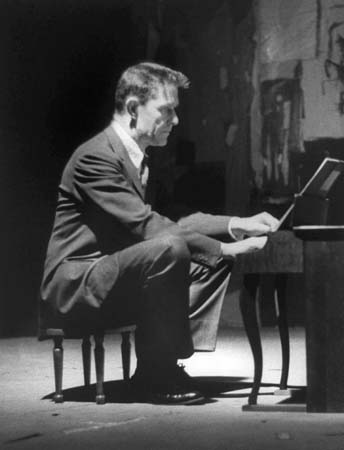
John Cage: Chance Sounds

John Cage was a revolutionary man, an experimental "composer" and the artist that altered the world of music and the relationship between (what we call) music and our lives. Cage is known best from his 1952 composition, 4'33", a musical performance, always lasting exactly 4 min. and 33 seconds, which consists of musicians pursed in position to play the first note on their instruments, which never comes.

He was also known as a philosopher, poet, music theorist, artist, printmaker, amateur mycologist and mushroom collector. He challenged and questioned the idea of music as a form of self expression and of sounds being anything more than just that, reverberations affecting our ears and interpreted by our brains. He talked about the sounds not created with force or forethought and the beauty within "silence".


Often the compositions that he created through chance operations take on a very beautiful nature. I find that the randomization of sounds creates a landscape for our ears that is unusual and maybe even uncomfortable, but compelling and thoughtful. My brain at times feels more involved in the processing of the music and at other times is able to let go of structure completely and feel almost complete bliss.

While I do not 100% agree with everything that Cage felt music should be, I see his impact on our culture and the creation process of musicians as incredibly significant. He was a true genius; taking an entire discipline and turning it on its head.

Finally I will leave you with the composition, Dream--written to accompany a Merce Cunningham dance--which I find serene and elegant, and also a closing quote for contemplation;

"There is no such thing as an empty space or an empty time. There is always something to see, something to hear. In fact, try as we may to make a silence, we cannot."

4.26.2011

Pedro the Lion:

I have a new music love.

It was one of those situations where I found a gem buried deep in the depths of the 16000 songs in my iTunes library (well maybe I was pointed to it). That gem is Pedro the Lion.

Pedro the Lion is an indie-rock band from Seattle that was formed by the front man, David Bazan. They are known for their "emotionally charged narratives", Bazan's deep and mournful voice, and their catchy but detailed melodies. At first listen, there wasn't a great deal that jumped out to me personally to catch my attention and pull me in. When listening superficially, the music seems somewhat flat. The genius of this band lies predominantly in the lyrics.

Today I want to talk more about their track, "Penetration" off of the album, Control. This concept album contains the narrative of a business man who is having marital and general life issues, focusing on themes such as infidelity, greed, vengeance, and the fear of death.

The song Penetration, co-written with Casey Foubert, is an exceptionally interesting track off the album. Pitchfork calls it "a reasonably cathartic requiem for a dotcom layoff, with chiming, Edge-like guitars and a brash, anthemic chorus". It is a song that does a better job at that initial hook and the more and more times you give it time and really listen, the more it gives back to you.


AESTHETICS

The track begins with catchy and heavy guitar rhythms and moves straight into Bazan's simple vocals. There is something very cathartic about this song. It feels almost like we're being massaged by the repetitive melody and and the switching back and fourth between the deep drum beat and the fast, higher pitched guitar riffs.


CONTENT

The song really reveals its cleverness and finesse in the lyrics. Every line hits you with poignancy and a critical air that joins multiple observations of society to make a unified introspective statement. The line, "Because if it isn't making dollars, then it isn't making sense" ties the song together, making the statement against corporate culture and how it has penetrated the ideals and actions of our society.

Have you ever seen an idealist
With gray hairs on his head?
Or successful men who keep in touch
With unsuccessful friends?

You only think you did
I could have sworn I saw it, too
But as it turns out
It was just a clever ad for cigarettes

Because if it isn't making dollars
Then it isn't making sense
If you aren't moving units
Then you're not worth the expense
If you really want to make it
You had best remember this
If it isn't penetration
Then it isn't worth a kiss

We're so sorry, sir
But you did not quite make the cut this time
We'd appreciate it if you'd get
Your stuff all out by five

Don't take it personal
Everyone knows you did your best
If it makes it easier
You should look at things from our perspective

Because if it isn't making dollars
Then it isn't making sense
If you aren't moving units
Then you're not worth the expense
If you really want to make it
You had best remember this
If it isn't penetration
Then it isn't worth a kiss


SOCIAL/HISTORICAL CONTEXT

The music of Pedro the Lion, in general, has been related to the writings of J. D. Salinger for their creations of narratives that observe the aspects of society such as alienation, family ties, death, religion, the loss of innocence, and and corruption. Bazan seems to write lyrics in the way that aligns more with a writer of literature than catchy songs, often taking him six to eight months to complete the process. He hides and reveals meaning in metaphors, references, and the stories that he creates.